
Why I'm so Bullish on Uber

In case you didn't know I like Uber. Actually, no, I love Uber. I love Uber as a customer and I love Uber as an analyst, for many reasons. It's a disruptive company which has brought about huge innovation in an industry that has been largely unchanged since its inception in the early 1600s. Any company that has the ability to almost single handedly disrupt a worldwide industry as big as the taxi industry is certainly one to take notice of and investors have. The company is valued at over $60 Billion, the highest valuation ever for a private company. In it's 7 year existence Uber has surpassed the likes of Honda, Ford and Nissan, and is quickly catching up to BMW and Volkswagen. This is something that can't be ignored.

This massive valuation doesn't come from nothing though. Uber has something, it has the business model. I always believe innovative and successful companies need two things; the business model and the technology. So far I think Uber has the business model, and that's by far the most difficult bit to get right. Think how many times you've heard people say the 'Uber for X' when talking about new ideas and start-ups. 'Uberisation' has become a commonly used term, it even has it's own Wikipedia page: https://en.wikipedia.org/wiki/Uberisation

As I write this Apple has announced a $1 Billion investment in Didi - Uber's main rival in China. This is a massive technology company investing in a business model and customer base.
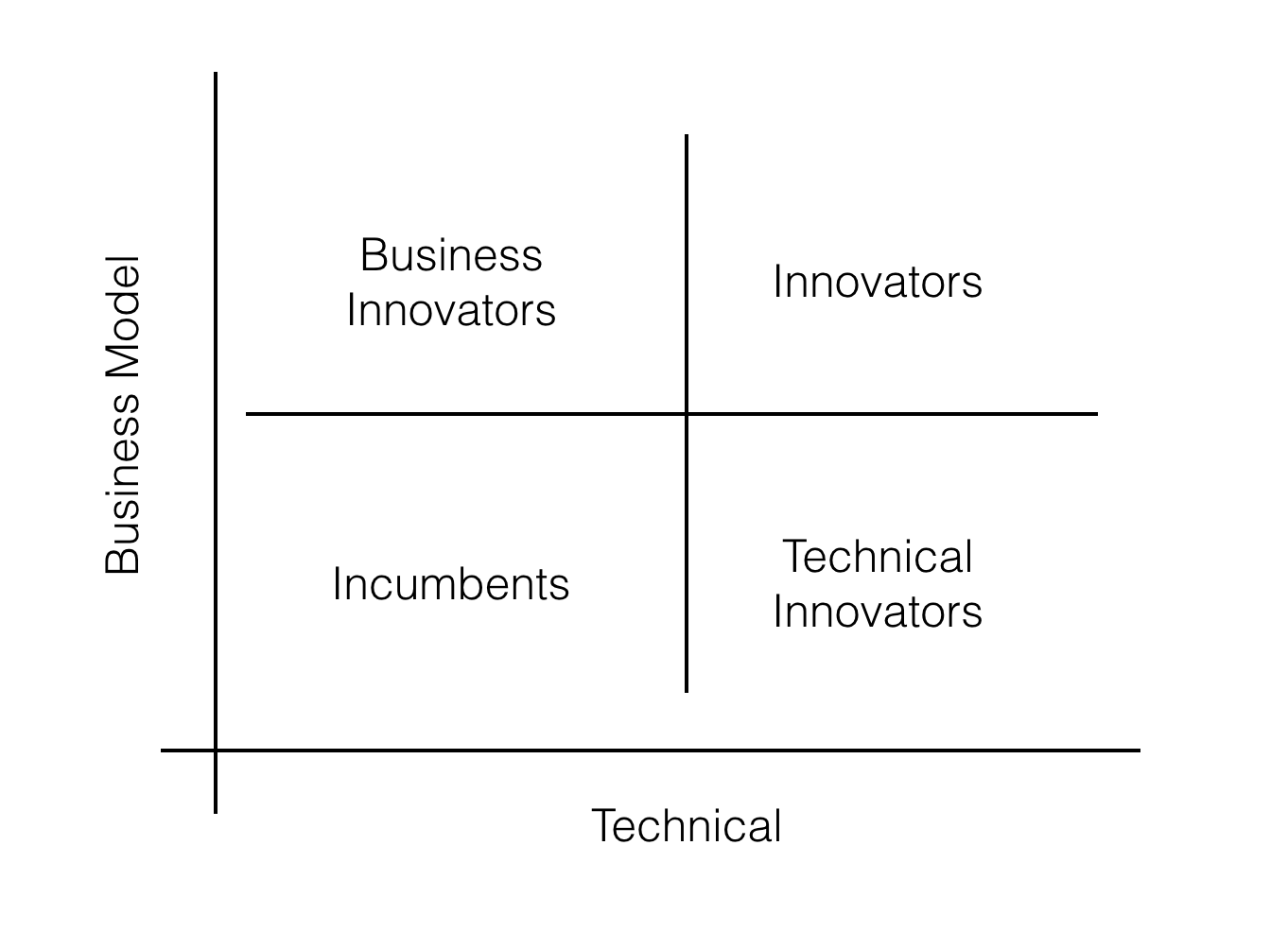
Innovation Quad

In the quad above it's easier to move right along the x-axis than it is to move upwards along the y-axis. Right now I see Uber being in the 'Business Innovators' sector.

So if Uber has got this huge valuation without the technology imagine how it will develop once it has it. But what is the technology? Well it's autonomous cars of course.

All Uber has to do now is sit and wait until fully autonomous cars become available in the next 10 years. Once this happens Uber can eliminate one of it's biggest costs, the drivers, and the service then becomes available to a much wider audience as it can charge much less. It could become as cheap as public transport for many journeys. Right now a journey from Vauxhall to Waterloo would cost £2.40 on the London Underground, and it would cost £5 on Uber Pool. Imagine how much that cost would drop if there was no driver and the vehicle was electric (It's not just about paying a drivers wages as with autonomous vehicles you potentially get much higher asset utilisation).

Now, almost every vehicle manufacturer (and some tech companies) is working on autonomous vehicles but so many of them are forgetting about the business model that comes with it. Remember that personal car ownership will die away as autonomous vehicles are introduced (Link) so how are they going to make their money? Uberisation.

You see once Uber has the technology it already has the worldwide customer base to take advantage of it while others may have the technology but have no one to sell it to.

It's true that some incumbents understand this. We've seen General Motors invest heavily in and partner with Lyft while BMW have their Drive Now on-demand service. The question is though; is this enough? And when comparing these to Uber they don't even come close.

Should the High Street Banks be worried?

The internet, coupled with mobile, has been a force to be reckoned with for almost every industry. Travel Agents have been made obsolete by Expedia, SkyScanner, Kayak and a whole host of others. The traditional taxi business has been massively disrupted by Uber and Lyft. Retail is now a very different beast thanks to the likes of Amazon. Newspapers, TV, Fast Food, Music, Hotels, the list could go on and on. There are however a few industries that are yet to really feel mobile internet's effects and one of these is banking (automotive is another but that post is coming soon). For as long as I can remember there's been one constant on the British High Street - the 'Big Four'. The 'Big Four' is a term given to the four biggest banks in the UK, these are Barclays, HSBC, Lloyds, RBS, and between them these banks own around 75% of the market [1]. This general lack of competition is bad for consumers as there's little incentive for any of these incumbents to change or do anything particularly different. In fact, if you look through their offerings not one of them stands out as giving anything above the rest.

Thankfully this might be about to change. There's a big, and quickly growing appetite by young and innovative start-ups to disrupt the old and traditional banking industry. These start-ups under the umbrella term of 'Fintech' are being built from the ground up with large investment from Venture Capitalists. They have none of the baggage that the incumbents have such as large overheads and legacy systems.

This new breed of financial business understands the frustrations and annoyances that a generation who have grown up with technology at their fingertips have. Companies such as Monese, Mondo and Atom are building banks made for the smartphone. They don't have branches, they don't even have website banking, everything is done from your smartphone. The sign-up process is made so simple, you sign-up on your mobile and scan your ID for verification which means you don't have to go into a branch to set-up your account as you would now with the legacy banks. Transfers abroad? No problem, all done from your phone and with zero fees. Going on holiday? No need to get foreign currency, just use your card as you normally would and pay no fees for foreign transactions.

It is this ease of use and transparency that the smartphone generation really understands and wants from everything they use, and why shouldn't they?

Unfortunately though this isn't something the high street bank seems to understand, and those that do can't do anything about it due to their legacy systems and costs and risks associated with building new ones at their scale [2].

"Replacing that tech is just so risky that no one else is going to try to do it. It is a multi, multi billion pound project that is going to take five to ten years, and even then risk failure." - Tom Blomfield, Monese CEO.

I recently switched to a bank that is supposedly 'different from the rest'. Except it isn't really. The app is horrible to use - it's design is terrible and if I want to do anything more than view my balance or transfer money to an existing payee I have to login to their website which takes about a million hours to get through the security (seriously, it's ridiculous). To set-up Apple Pay I had to phone them, yes actually speak to a human being who asked for my every intimate detail just to complete an action that should be so simple.

As I mentioned earlier, it is these annoyances that the start-ups understand and can use technology to do something about.

It's not just the high street bank that's being disrupted either. A whole range of financial services are being switched to mobile. Take Curve for example. Curve is a service that puts all of your cards in to one and guess what, it's all controlled from your mobile. Just scan all of your cards including Visa, MasterCard and American Express and set one as your default. Then just use your Curve card (which is a MasterCard) anywhere. If you want to use a different card just select it in the app. You can even use your American Express in places that don't accept it, and importantly get the same rewards and protections. It even lets you get cash from your credit card without paying fees.

Investments and stock market trading are another financial services area being disrupted. Take a look at Nutmeg or Robinhood who are offering free or very low rate investment and trading platforms all built around simple and easy to use mobile apps.

So, back to the exam question, should the high street banks be worried? Absolutely.


What do you think of the current banking industry, can it change and keep-up? Leave your comments below.

If you enjoyed this article or found it useful please do hit like and share :)


Sources:

[1] http://www.telegraph.co.uk/finance/newsbysector/banksandfinance/11212515/Full-investigation-into-the-dominance-of-big-four-UK-banks-confirmed.html

[2] http://www.techworld.com/mobile/mondo-ceo-tom-blomfield-explains-how-build-next-generation-digital-bank-3618866/3/


The Road to Autonomous Vehicles

We all know that autonomous cars are coming but a question that is often asked is when. Well the following is how I like to think about how the development of autonomous vehicles will unfold. I like to think of it in four stages:

Stage 1 - Feet-off:

This stage has already been reached, in fact, it was reached a few years ago with the introduction of adaptive cruise control and slightly more recently traffic jam assist where the vehicle will slow down even to a halt and then progress again once the traffic moves. Currently the majority of a journey could be completed feet-off.

Stage 2 - Hands-off:

We're almost at this stage as most higher end vehicles allow the driver to take their hands off the wheel for a minimal amount of time and the car will steer along the motorway. Full hands-off is something that is certainly technically viable right now but is limited by safety concerns. As has been seen with Tesla's Autopilot people are idiots behind the wheel (or not in this case). This means that all manufacturers currently require a hand to be placed back on the wheel within 10s of seconds.

It'll likely be around 12-18 months before manufacturers allow full hands-off driving for extended periods of time.

Stage 3 - Eyes-off:

In this stage there still needs to be a driver behind the wheel ready to take over in case of emergency but that driver does not need to be concentrating on the driving or be doing any of the driving. Here you could see the driver perhaps in the drivers seat but reading a magazine or using their phone. This will be largely during motorway type journeys.

As with feet-off driving the technology is pretty much there with manufactures such as Volvo going through thorough testing and refinement. Interestingly, Volvo have pledged that by 2020 nobody will be killed or seriously injured in their cars and in the US since 2009 this has already come true for the XC90 and 9 other models.

Full eyes-off driving is probably another 3-5 years away for the mainstream manufacturers. Perhaps two years away before Tesla puts out a Beta product.

Stage 4 - Driver-off:

This is the final fully autonomous stage where no driver is required to be in the vehicle. This requires some quite substantial developments to happen not only in vehicle technology but in infrastructure, legislation and importantly culture. Following several years of eyes-off testing and refinement it's likely that the vehicle technology will be there and legislation will probably have caught up to an extent that innovators will find a way to bring driverless vehicles on to the roads.

Infrastructure is something that is a concern currently. Given how different roads and associated infrastructure is around the world there may be difficulties, for example, road works are often ad-hoc with no real standard way of closing off lanes and roads, how will autonomous vehicles navigate around ad-hoc road works? Autonomous vehicles will enable great changes to our cities as large car parks become unnecessary and a thing of the past there will need to be large drop-off areas created which currently doesn't exist.

The other thing that needs to happen is a culture change. People today are generally unsure about autonomous vehicles with many say they wouldn't trust or use one. However, as autonomous features are slowly introduced through stages 2 and 3 this nervousness will wane.

This level of autonomy is around another 10 years off, perhaps 15 years for the majority.

So that's how I think about the development of autonomous cars. Don't forget to follow for more posts in the future.

3 Technology Trends to Watch in 2016

It's been a great 2015 for technology as it spread in to every part of our lives. Here's what to look out for in 2016:

1) Virtual Reality

2015 has been an interesting year for Virtual Reality as developers have been getting their hands on hardware and have had time to develop and understand what does and does not work for consumers of VR.

2016 will see a major milestone for VR and that is the release of the consumer version of the Oculus Rift. Coming in early 2016 the Rift will require a fairly high end desktop PC which will be a majorly limiting factor in its success but nevertheless it's an important first step for taking VR to the consumer. In addition to Oculus releases the Playstation VR, codenamed Project Morpheus, will be released in the first half of 2016 with a potentially huge reach.

It's been getting a lot easier for creators too to create content for VR. Facebook have introduced support for 360 degree videos which has been snapped up and tried by big organisations such as the BBC, and after GoPro's acquisition of Kolor earlier in 2015 you can bet that 2016 will see more and more VR content being created in 2016. As this Grandma shows VR content is just awesome.

In addition to VR there's also it's cousin, AR - Augmented Reality. With Microsoft Hololens expected to be released early 2016 and rumours swirling of Google Glass making a comeback it's likely that this will all help make 2016 a great year for Virtual and Augmented Reality.

A question remains though and that is will the smartphone, via something like Google Cardboard, rule VR or will dedicated hardware rule?


2) Personal Fitness & Health Tracking

Over the last couple of years, and particularly in 2015, fitness tracking has really developed. It's been led by new and young companies such as Fitbit and Withings. As a slight aside, Fitbit looks like it had a bumper Christmas  with it's apps trending on the App and Play Stores and it's shares jumping on opening on Monday. With a huge range of smartwatches now available with fitness tracking as a major feature and lots more coming for both Android and Apple fans (Apple Watch 2 for example) I think 2016 promises to be a bumper year for fitness and health tracking.

As technology around the IoT (Internet of Things) develops we're going to see more and more devices connected and constantly monitoring us and our environment - from alarm clocks to smart scales and more.

An outstanding question though is how will people use the data they get from these devices? Apple's health kit has gone some way to helping people understand all of their data from a huge range of devices and measurables but it still requires some analysis by the user to get actionable evidence out. Given that the vast majority of these devices are not and will not be certified medical devices due to the huge barriers another question is how will healthcare professionals use the data, if at all?


3) Electric Vehicles

Helped along slightly by the VW scandal and government incentives electric car sales have been on the up year after year. Tesla has shown that good electric cars are possible and they can replace your Diesel or Petrol motor. The new car line-up for 2016 is looking good and with the huge number of new and exciting full electric and hybrid cars being released it starts to look extremely impressive.

The Tesla Model X will start shipping in big numbers throughout 2016 and the Tesla Model 3 - a supposedly affordably full electric BMW 3 Series competitor will be announced later in the year.

Tesla is set to get some big competition though as the very mysterious new company, Faraday Future, is set to announce full details of their autonomous electric car at CES in January. Faraday Future is just a couple of years old and has been very secretive about what its doing. Despite this they've attracted top management and engineers from Tesla, BMWi and a whole host of other manufacturers. They've also got massive investment and are opening a $1 Billion facility in Nevada, USA very soon. Not only are they developing autonomous electric cars but also working on innovative business models likely to be similar to the smartphone model where revenue continues after the hardware has been purchased/leased.

While there'll be lots of full electric cars announced in 2016 many won't reach the road until 2017 or later. However, a stepping stone to this has been gaining huge traction over the last year and that is plug-in hybrid vehicles (PHEVs). Mitsubishi have had huge success with the Outlander PHEV, in fact, they've been unable to meet demand and the buyers have found their vehicles have had almost zero depreciation due to demand. For 2016 though there's a huge list of new PHEVs coming on to the market, actually, almost every new car will have a hybrid option. Here's a few to look out for:

  • BMW 5 Series
  • Land Rover Discovery 5
  • Porsche Panamera
  • Peugeot 308 R
  • Volvo S90
  • Honda NSX
  • Mercedes E-Class
  • VW Tiguan


What additional technology trends will you be watching through 2016?


-End-

Everything as a Subscription

We're all well aware of the popular business model that is 'X as a Service' (XaaS) where by, typically a business, will pay for something like Software but it is delivered remotely, in the case of Software via a Thin Client rather than via Download or a CD (whatever those are). This means that users always have the latest version and resource intensive applications can be run on less resourceful devices. This is great for services where a physical product is not required but what about when there is? Well, now there's a business model that is growing massively in popularity and that is the 'subscription economy' or maybe it should be EaaSub (Everything as a Subscription)? There's now hundreds, probably even thousands of businesses offering products via subscription and there's really no limit as to what you can get. We all know about the usual ones like Netflix and Magazines/Newspapers but here's some you may not know about:

It's even spawned new support businesses such as Zuora who now provide subscription management software to businesses.

For businesses this model has a lot of positives, it provides a predictable revenue stream and by encouraging customers to pay upfront it gives the cash flow required to support operations. In high competition industries it also locks in the consumer and stops them heading for the competition. For the consumer it's a hassle free way to get the consumable products they require often.

It's important though that there's some flexibility as consumers don't want to think they're paying for something that they don't need e.g. if they get a toothbrush monthly but only really need one every two months then they're likely to cancel.

So what's next for the subscription model, could we see typically service orientated businesses offering subscriptions, maybe something like unlimited Uber rides for £X/month? Subscription Hotel rooms? Could we see Apple expand it's iPhone Upgrade Program to it's other products, could Samsung start offering TVs and other large consumer electricals by Subscription?